
Brands Get Recommended 44% More Often in ChatGPT When They're Cited as a Source (Study of 10,000 Responses)
We analyzed 10,000 ChatGPT responses to find out whether getting cited as a source makes a brand more likely to be recommended in ChatGPT, and which types of cited pages have the biggest impact.
The citation-recommendation pattern was consistent across page types. Anytime a page from a brand’s website was cited as a source, that brand was recommended significantly more often. The higher recommendation rate held true regardless of whether the cited page was a product page, category page, homepage, or an informational article.
Key Findings
- Any Page: Brands were recommended +44% more often anytime any page from the brand was cited as a source.
- Product Pages: Brands were recommended +46% more often anytime a product page on the same website was cited as a source.
- Category Pages: Brands were recommended +39% more often anytime a category page on the same website was cited as a source.
- Homepages: Brands were recommended +37% more often anytime a brand’s homepage was cited as a source.
- Articles: Brands were recommended +36% more often anytime an article on the same website was cited as a source.
The Data by Page Type
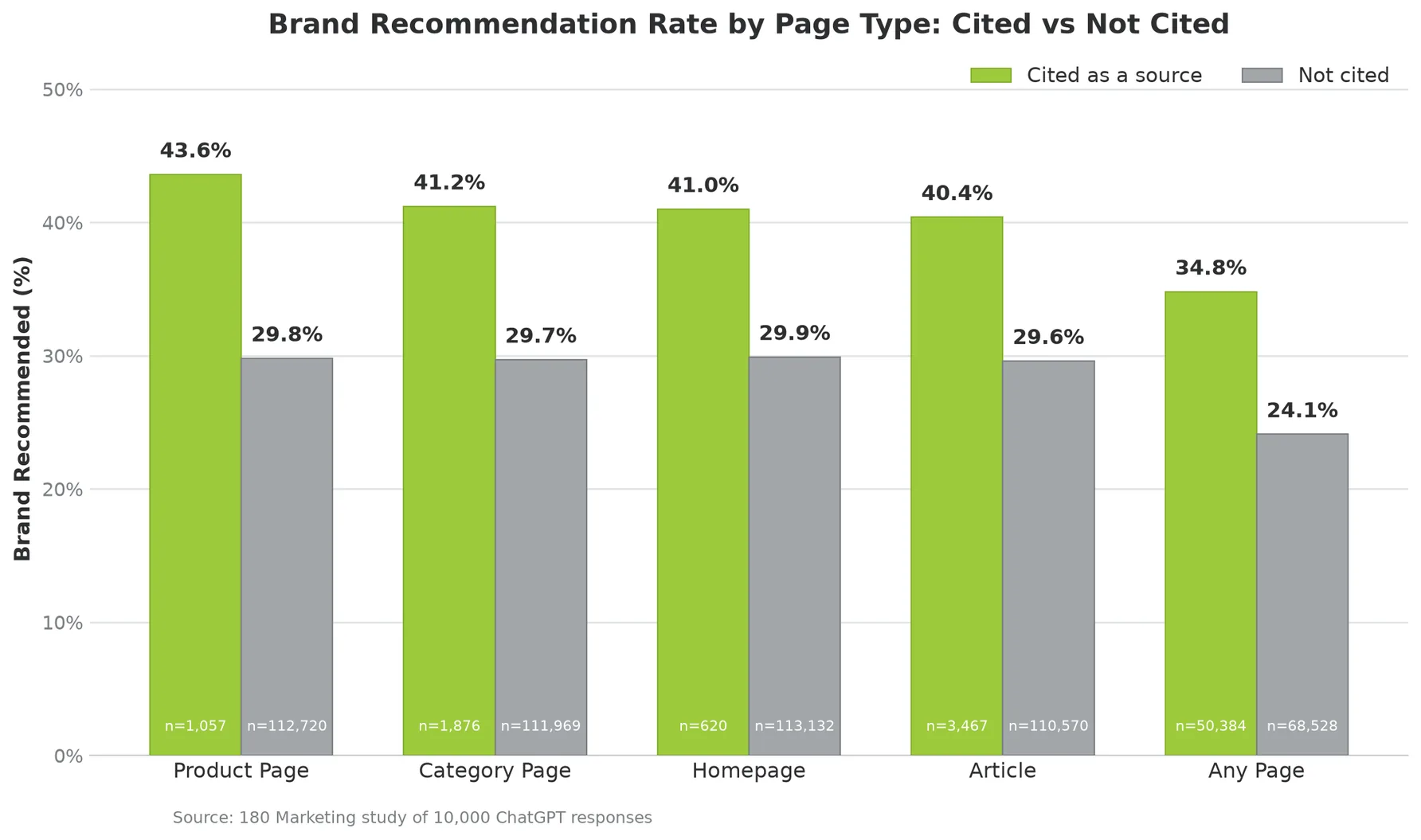
The chart below shows the recommendation rate for each page type, comparing responses where a page of that type was cited as a source versus responses where a page of that type was not cited.
| Page type cited | Recommended % when cited | Recommended % when not cited | Relative lift |
|---|---|---|---|
| Product page | 43.6% | 29.8% | +46% |
| Category page | 41.2% | 29.7% | +39% |
| Homepage | 41.0% | 29.9% | +37% |
| Article | 40.4% | 29.6% | +36% |
| Any page | 34.8% | 24.1% | +44% |
The data shows that brands get recommended much more often anytime one of their pages is cited as a source in ChatGPT, regardless of what kind of page gets cited.
Product pages are the strongest signal, which makes sense, but the gap between product pages and articles is smaller than I expected. Getting an article cited (40.4%) gets you almost as far as getting a product page cited (43.6%).
Methodology
Here is a summary of how this study was conducted.
- We built a list of 1,000 prompts someone might ask when looking for product recommendations using a “What is the best ____” type of format. For example, “What is the best protein powder” or “What are the best baby strollers”.
- Each prompt was run 10 times, giving us 10,000 total ChatGPT responses. Running each prompt 10 times let us measure how often each brand was recommended across 10 runs, rather than relying on a single response.
- For every response, we analyzed which sources ChatGPT cited and classified each cited URL by page type: product page, category page, homepage, or article.
- We looked at how often a brand was recommended when a page on the same domain was cited as a source, and then compared the recommendation rate to how often a brand was recommended when none of its pages were cited as a source.
- The data was broken out by page type to better understand if some page type citations are more impactful than others.
Action Items for eCommerce Store Owners
Getting your website cited as a source is one of the highest-impact ways to get recommended more often in ChatGPT, and the cited source doesn’t even have to be your product page.
Here are some actionable tips to optimize your product pages and articles for AI assistants.
Product Pages
- Include detailed product specification tables
- Clearly highlight the product’s unique selling points
- Make it clear who the product is intended for and any use cases
- Include an FAQ section answering common customer questions
- Display customer ratings and reviews
- Include product structured data
Resource: A 6-point scorecard for AI-ready product pages
Articles
- Start the article with any key takeaways or insights
- Write in clear, simple language (think Wikipedia)
- Focus on short, concise sentences
- Include relevant data and statistics, while citing any sources
- Include quotes from industry experts when applicable
- Format subheadings as questions wherever possible
- Give a concise 50-150 word answer after each subheading before elaborating on nuances
- Avoid analogies, since they can dilute the article’s focus
The more often pages on your website get cited as a source, the more often your brand will get recommended.